

| |

|
In the early years of coal mining in Cape Breton, the coal
industry employed the use of "pit ponies" to haul
coal from the mines and later, as the workings progressed,
in the mines themselves. Operators of these mines were compelled
to use these "ponies" both by considerations of
economy and necessity, and their use is said to have been
instrumental in making coal mining a success.
Generally, the ponies were maritime bred, bought from dealers
or farmers, and were by far the most satisfactory class of
horse to deal with. They needed some training, but proved
easier to train than the Western horse.
The selection of the pit pony was a matter of extreme importance.
Various characteristics of the horse were weighed before it
was chosen for work in the mines. For instance, because of
low roofs, steep grades and forced production, a pony must
be low set, heavily bodied and heavily limbed with plenty
of bone and substance. It must be low-headed and must be "sure-footed"
and should be not under five, and possibly not more than 14,
years of age.
The weight of the animal was important because heavy loads
had to be moved up and down steep grades that, in turn, necessitated
sure-footedness because of road conditions.
Another consideration was the temperament of the pony. A nervous
or shy horse would be very expensive to break in and would
cause a great deal of lost time. A good pit horse was one
that was even tempered and kind. A vicious horse was a menace
to the drivers, liable to cause bodily injury and/or fatal
accidents.
Stable conditions were very important and much was done to
tend to the comfort of these animals and lengthen their term
of usefulness. In the stable, the height of the roof was to
be seven feet when a five-foot horse was in use. It should
be able to raise its head and relax its muscles because it
had to work all day carrying its head low. Ventilation was
to be arranged so that the direct current would not strike
the horses. As little wood as possible was used in the construction
of the stables to lessen the chance of fire. All stables were
well drained with pipes and well whites washed for sanitary
purposes.
The stableman usually shod the horses with shoes made on the
surface. Sometimes, a ferrier went into the mine when a higher
degree of shoeing skill was required. He would take the measurements
underground and make the shoes on the surface.It was desirable
that the horse have only one driver who would take more pride
in the animal and so that they might both understand one another.
It is true that a horse's disposition was spoiled when drivers
were changed.
The roadways were to be kept in the best possible condition
to prevent accidents. The roof was also to be carefully brushed
to rid it of protruding booms and rocks that might cause head
injury to the horse.The horses were taken below ground in
a cage or were walked into the slope mines on the footpath.
Their daily working shift was normally the same as a man's
and drivers did not like their ponies to be double-shifted.
When the animal got older, their work period was usually reduced
to four hours. They generally stayed below ground for approximately
five years, unless killed or maimed, and then they were either
moved or replaced.
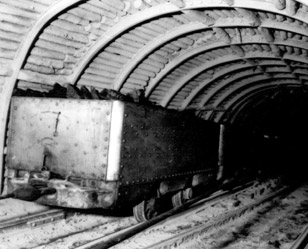
The work of the horses was as follows: "They pulled material
in coal boxes from the shaft or slope bottom to the working
places and pulled the filled boxes to the point near the surface,
and in the later period to where underground sections converged.
They were used in the same manner as railway yard shunting
engines."
The efficiency of pit ponies depended upon the manner in which
they were treated and the amount of food they received. A
man (stableman) was hired to take charge of the underground
stable and also to take care of and feed the horses. Usually,
an hour before work, they were fed hay, watered and grained.
A constant supply of pure water was considered one of the
best investments possible in animal care. At each landing
a generous supply of clean water was placed where it would
always be available for the horse. This would prevent gorging
and eliminate many ailments that often proved fatal.
GO
TO PAGE 1 |
2 |
3
|
|